
SAIL — The Private AI Performance Platform for Legal Work
Grow your business. Protect your knowledge. Your AI.
Your years of precedent are an asset you own,
now one question away. Close more matters, faster.
Your choice of AI. Your data. Your deployment.
Introducing SAIL
Grounded in your business and client history, SAIL drives new matters to close.
- Grow client matter volume.
- Shrink cycle time to matter close.
- Protect your and your clients' data.
- Build an institutional asset you own.
SAIL gathers your business knowledge from the apps you already use, runs a local AI over it to draft new work, and enables you to use the frontier AI of your choice to finalize work product, all without sharing confidential information.
See how it worksSearch
Ask across every matter your business has run. Found once, available always.
Draft
The system drafts from your own precedent, in your own language.
Review
Checked against your checklists and your standards and against the frontier AI of your choice.
Automate
SAIL encodes your standard operating procedures as workflows you own, so that the system learns progressively how you work.
The problem
Big problems for law practices, legal-services providers and corporate legal departments.
01
Institutional knowledge is scattered across apps and people.
Years of matters, templates, research, and judgment sit across a matter system, a document store, email, chat applications and people's memory. Ask whether your business has handled this before and finding out costs more than starting over.
02
Your people are already using the best AI, with or without you.
Lawyers reach for the strongest model available, on a personal account if that's what it takes. The question is not whether the frontier AI gets used. It is whether anything confidential goes with it.
03
You don't want to share it all with third party AI.
Handing a frontier AI your institutional knowledge also means sharing your client's confidential information into systems built to learn from it, under terms that shift without much notice.
04
AI costs grow with usage, eating into margins for fixed fee and flat rate work.
The more you work with third party AI, the more it costs. Per-seat pricing charges you for every new lawyer, paralegal and contractor. And enterprise value accrues to the AI provider.
Corpus activation
“Have we done this before?” now has an answer.
Example: Entity management
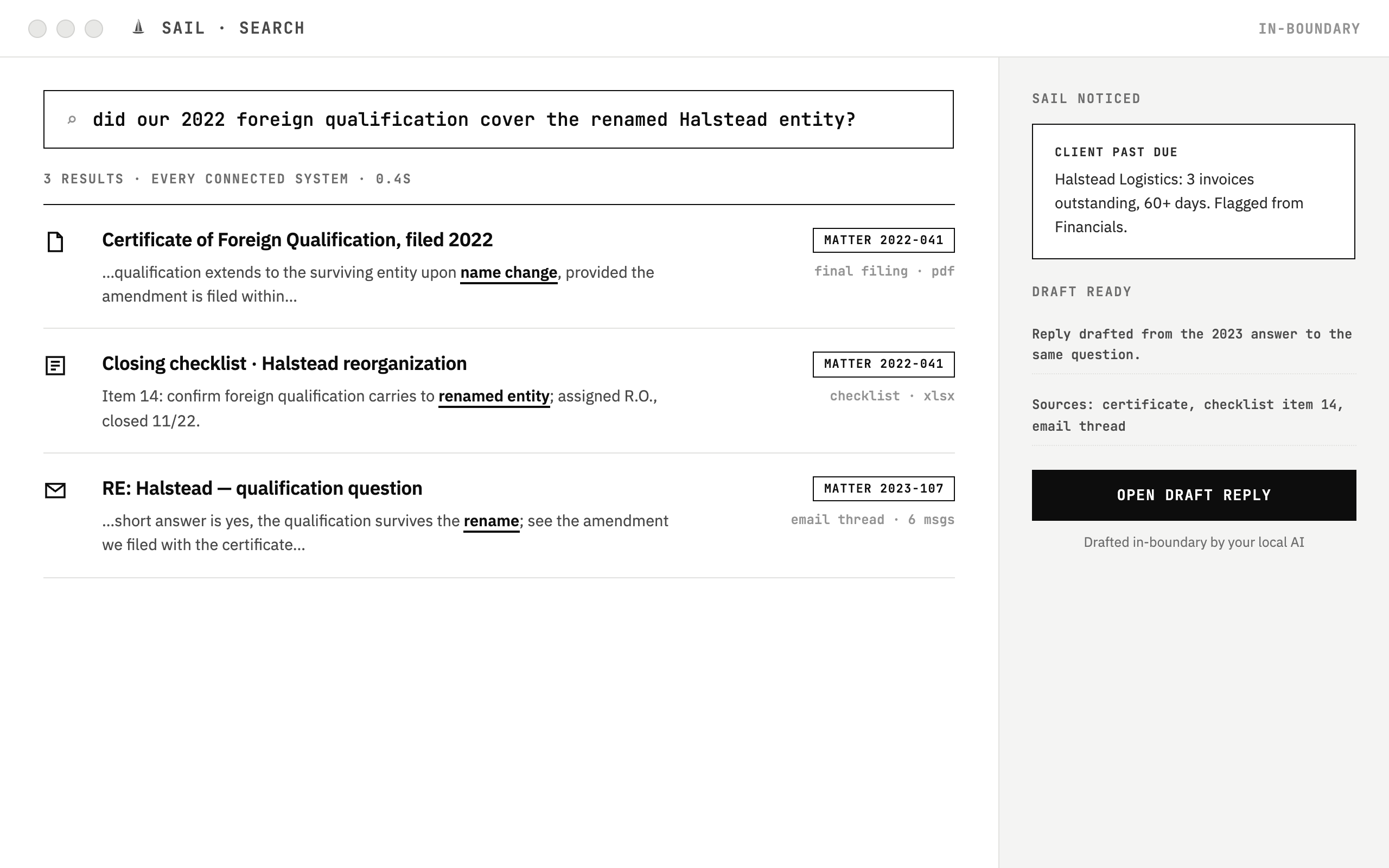
A client asks whether the foreign qualification you filed in 2022 covered the entity that has since been renamed. The answer exists in a final filing, a closing checklist, and an email thread, filed by three different people.
Search returns all three with the matter each belongs to, and SAIL flags that the client is past due on several invoices. SAIL drafts a reply from the language your team used the last time the same question came in.
Example: Contract review
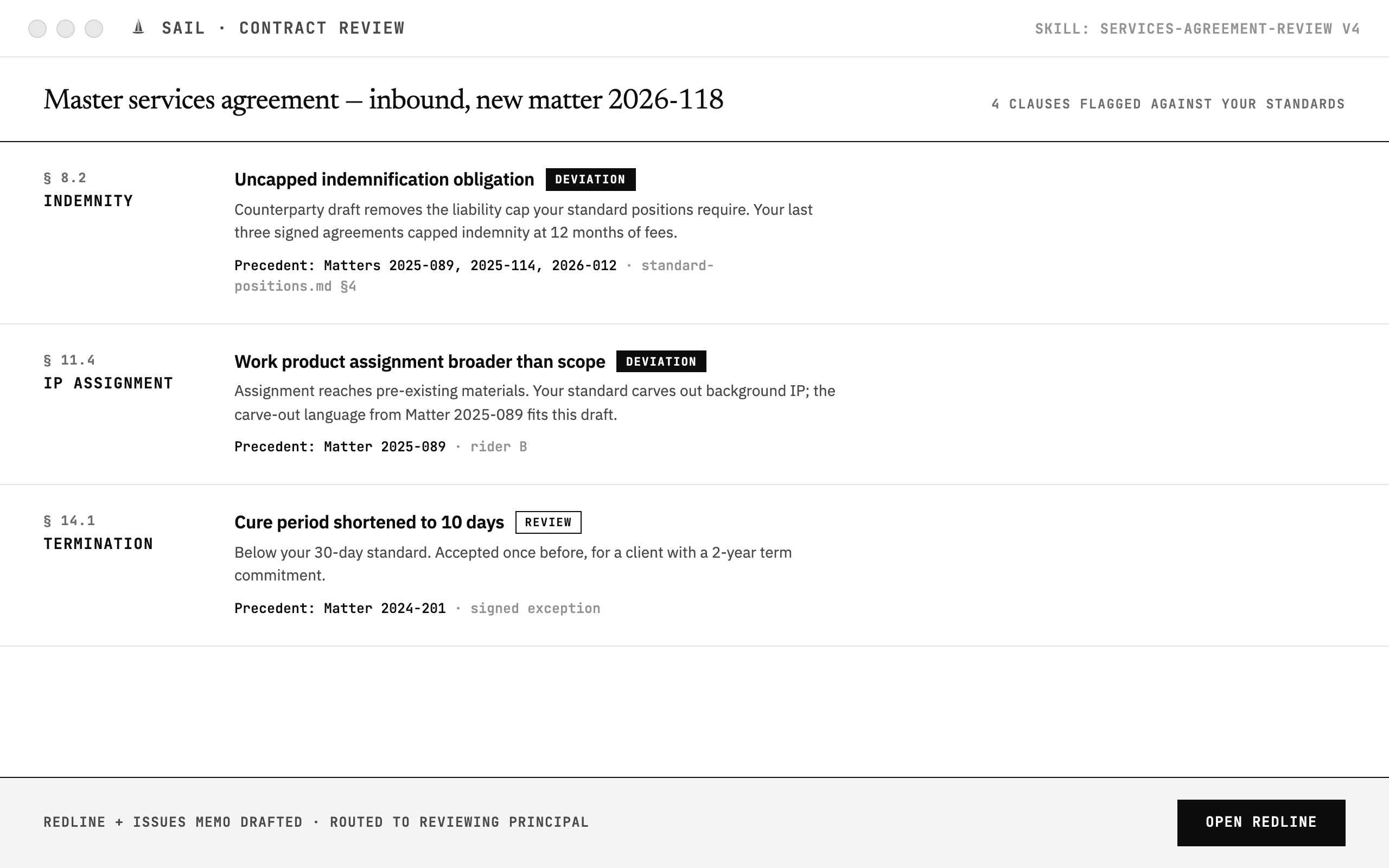
On submission of a new matter by your client, your contract-review workflow finds the clauses your standards call out and cites prior matters where the output took similar positions.
The boundary
Use the frontier AI of your choice without handing it your, or your clients' confidential information.
SAIL's Masking Engine (patent pending) masks details like names, parties, amounts and other identifying facts with neutral placeholders before you submit prompts to Claude, ChatGPT, Gemini or AI of choice.
The frontier AI does its reasoning on de-identified version so that you can take advantage of superior inference without giving it unnecessary details. When the answer comes back, SAIL restores the real details inside your boundary.
See how masking worksOwn your AI advantage
You own the deployment, and everything it learns.
The platform is SafeIdea's. The deployment, workflows and data are yours. SafeIdea cannot see your matter content.
| What you receive | Form |
|---|---|
| The deployed instance | A single-tenant server or service dedicated to your organization. |
| Every connector's configuration, and the data it carries | Yours; the connector code is SafeIdea's.Matter system, CRM, financial system, document store |
| Your workflows | Files your business authors, edits, and keeps |
| Your Masking Dictionary | Inside your deployment, never transmitted |
| All matter content and every index built from it | Inside your boundary |
| The audit record | Yours to produce to a regulator, client, insurer |
Aligned economics
SAIL costs fall as your matter volume rises.
Grow matter volume at higher margin: SAIL is licensed per site. Every lawyer, paralegal and contractor is welcome.
1 · SAIL License
2 · Everything else — licensed by you, directly, at cost
The same ownership that grows your business builds enterprise value.
The market
Win the deals confidentiality concerns are costing you.
44% of corporate law departments named confidentiality as a barrier to using alternative legal-services providers, up from 26% two years earlier .
Whether the data you hold are a client's, a law practice's, or your own company's, your organization has confidentiality duties. SAIL provides a clear account of where data lives and who can reach it. Its private system design leaves SafeIdea no path to your matter content. Access is yours to grant.